
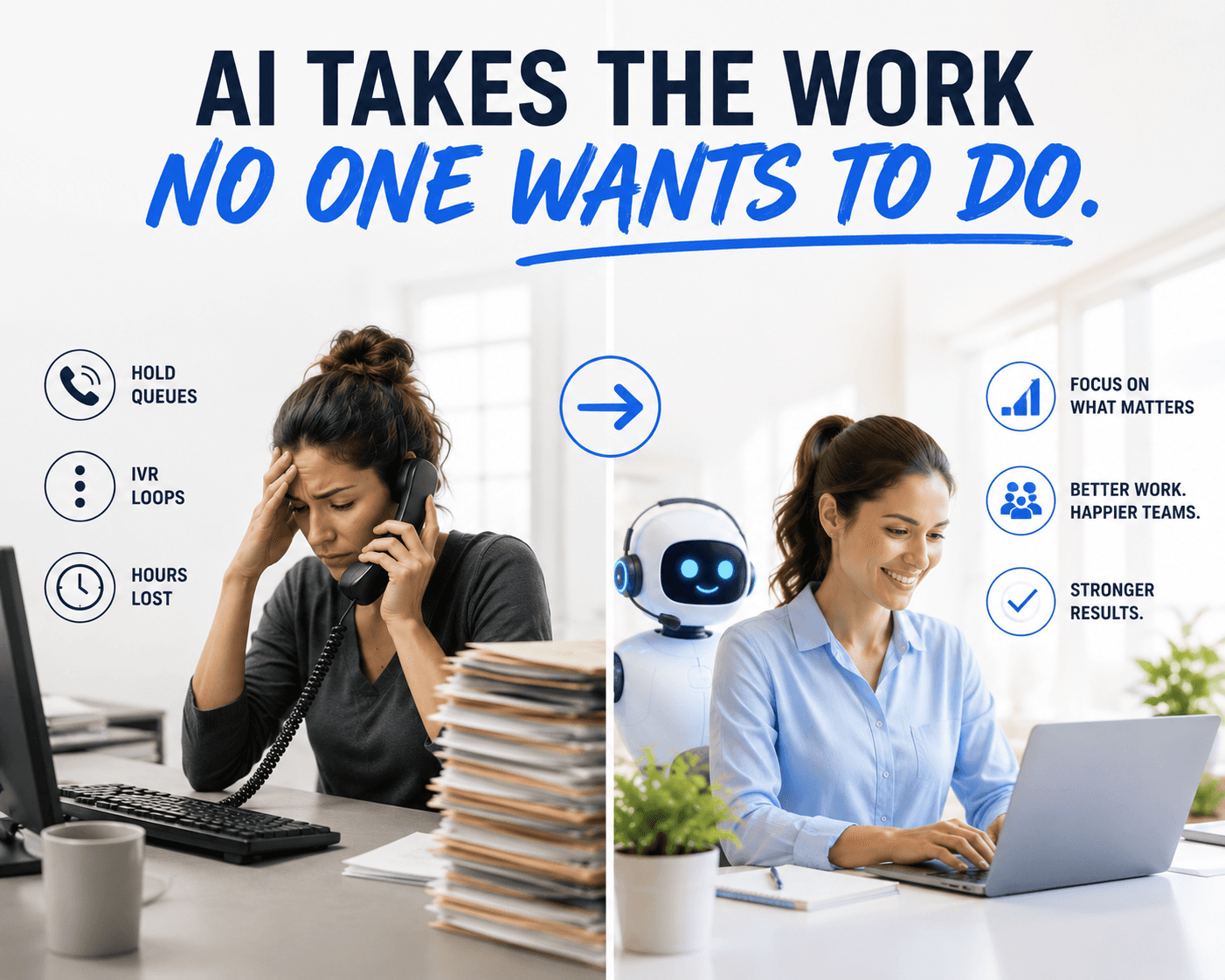
It's about the work itself, and the people who keep leaving because of it.
Most people assume AI adoption in healthcare revenue cycle management is about one of two things. Cutting costs, or replacing people.
It's neither.
The real story is something almost no one is talking about publicly, even though every operator in the industry is living it.
The Conversation That Made It Click
Last week I was on a call with the CEO of a billing company. 615 people, serving a portfolio of healthcare providers, running claims follow-up, eligibility checks, and verification of benefits at scale. They had reached out to us organically after seeing what we were building.
My first question was simple. What's actually driving you to look at AI right now? Is it cost? Is it efficiency? Something else?
His answer surprised me.
It's not about cost, he said. The biggest problem is attrition.
His team turns over at 25 to 30 percent a year. And once we started doing the math out loud, the full picture got clearer than either of us expected.
What a Day in a Billing Operation Actually Looks Like
A biller gets assigned 100 claims to work in a day.
After navigating IVRs, sitting in hold queues, getting transferred, dropped, and redialing, they finish 16 to 20. The other 80 sit. Not because the biller is bad at the job. Because the job is structured around waiting.
The average payer call runs 20 to 30 minutes. Most of that time is hold music. The actual conversation with a human agent at the payer is often less than three minutes. Sometimes one minute. Sometimes zero, because the call gets dropped and the biller starts the queue over from scratch.
Now multiply that experience by every day, every week, every month.
You're asking smart, trained people to spend their working life listening to hold music and clicking through phone trees. That isn't a job most people want to keep doing.
So they leave.
The Real Cost Is the Cycle That Replaces Them
And then the math that doesn't show up on the P&L starts to show up everywhere else.
Every new hire takes two to three months to ramp to full productivity. RCM isn't intuitive work. New billers have to learn payer-specific quirks, claim coding logic, your software stack, your escalation paths, your client SLAs. By the time they're independent contributors, you've already paid for them through a quarter of partial output.
While they're ramping, someone else is training them. That person isn't billing either. So every hire costs you not only the new hire's ramp time, but a fraction of a senior biller's productive capacity on top of it.
And because you can't risk being short when claim volumes spike or when a payer changes their portal and follow-up volume doubles overnight, you have to over-hire. So you're carrying a permanent capacity buffer.
Add it up.
You're running a parallel hiring engine, a parallel training engine, and a permanent capacity buffer, all just to maintain the team you thought you already had.
That isn't an inefficiency line item. That's a structural tax on the entire business.
Why This Gets Missed in Almost Every AI Conversation
When AI in healthcare RCM gets discussed, it almost always gets framed in one of two ways.
The vendor pitch is usually: cut your costs, reduce your headcount, do more with less.
The buyer concern is usually: are we replacing our team, will the technology actually work, what happens to the people we've trained.
Both framings miss the actual operating problem.
The work that's driving attrition is the exact work AI voice agents are best at. IVR navigation. Hold queues. Repetitive eligibility and status calls. Verification of benefits. Claim status follow-up. Work where the path is the same every time, but a human still has to sit through it.
That work is structurally suited to automation precisely because it has a deterministic shape. The IVR menus don't change much from call to call. The hold queue is the same hold queue. The data being extracted is the same data. It's the kind of work that an AI voice agent can do at scale, in parallel, without breaks, without burnout, and without quitting in month seven.
What Happens When the Work Moves
When that work moves to AI, the humans on your team aren't replaced. They're freed.
They handle escalations. They work payer disputes that require negotiation. They write appeals that need a real narrative. They take the patient conversations where empathy and judgment matter. They manage the cases that genuinely require a human voice on the line.
In other words, they do the work that made them want this career in the first place. The work that uses their training and judgment. The work that doesn't make them want to quit.
Same headcount. Different work. Much lower attrition. And the hiring and training tax that nobody puts on a slide starts to disappear.
The Shift That's Actually Happening
This is the shift I think the next 18 months in healthcare RCM are really going to be defined by.
It isn't AI saving you money, though the unit economics improve.
It isn't AI replacing your team, though the role mix will change.
It's AI taking the work that no one wanted to do anyway, so the people you've already invested in actually stay. So the institutional knowledge you've built doesn't walk out the door every nine months. So your senior billers stay senior long enough to mentor the next generation, instead of getting pulled back into the trenches to backfill churn.
The operators who see this first are going to compound the advantage. Lower attrition becomes deeper expertise. Deeper expertise becomes faster resolution. Faster resolution becomes higher recovery rates. Higher recovery rates become better margins. The whole stack improves because the work humans do becomes work humans want to do.
That's the real story of AI in RCM right now. Not cost. Not replacement. Retention through better work.
If You're Running an RCM Operation
If you're a COO, VP of revenue cycle, or CEO of a billing company or provider organization, the question worth putting in front of your team this quarter isn't whether you can afford AI voice agents.
It's whether you can afford the attrition curve you're already on without them.
The structural tax is already being paid. The only question is what you have to show for it.
---------------------------------------------------------------------------------
At Operator Labs, we build AI voice agents for healthcare revenue cycle workflows: payer follow-up, eligibility checks, verification of benefits, and claim status calls. If the conversation in this post sounds like one you're already having internally, we'd love to talk.