
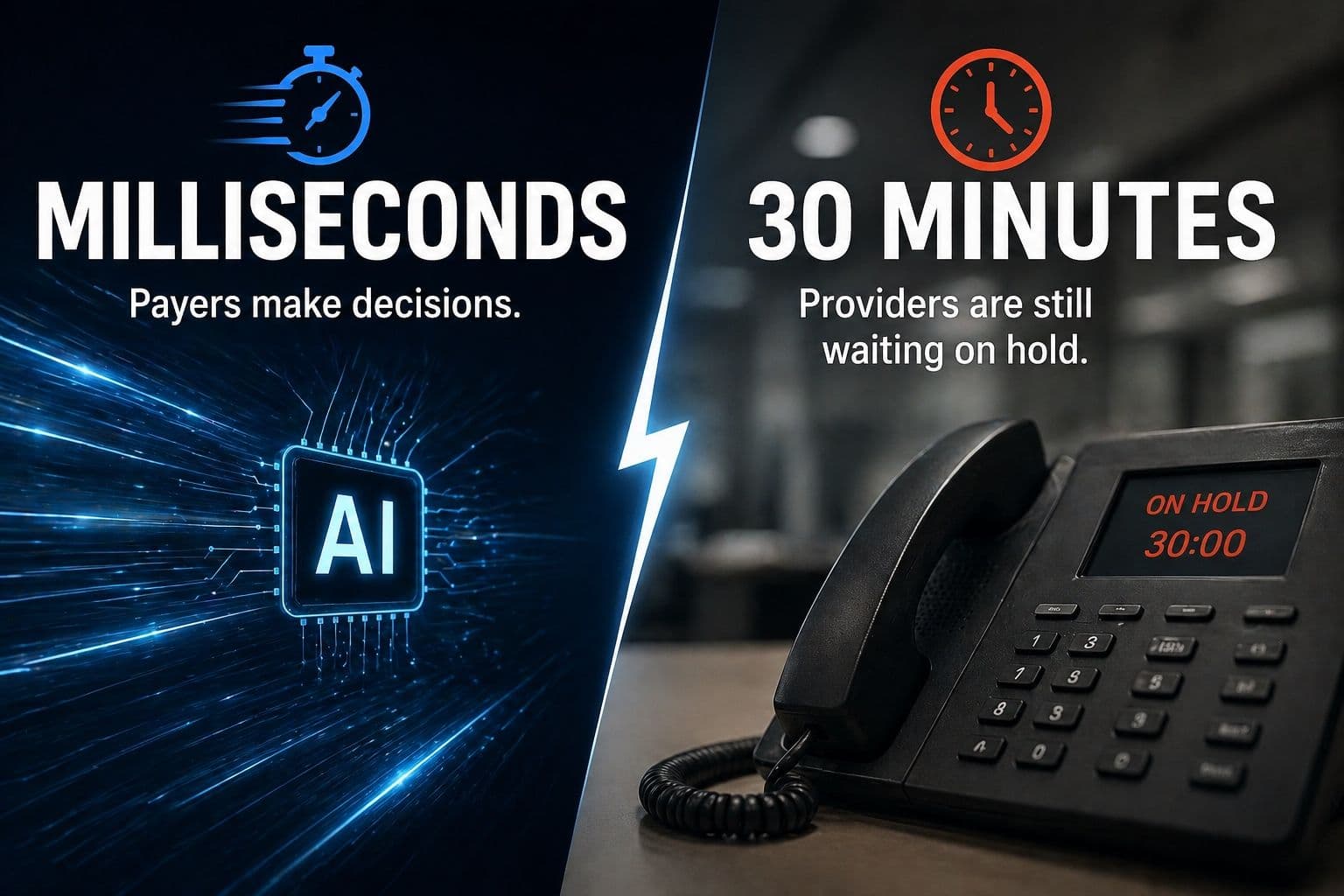
In today’s healthcare revenue cycle management (RCM) environment, a critical imbalance is emerging — one that is directly impacting cash flow, operational efficiency, and financial performance.
Payers are making decisions in milliseconds, while providers are still waiting 30 minutes on hold. That gap is where revenue gets stuck.
The Growing Cost of Denials in Healthcare RCM
Each year, billions of dollars in healthcare claims are denied. Industry estimates suggest that over $40 billion in revenue is delayed or lost annually due to denials, much of which is ultimately recoverable through effective denial management and claims follow-up.
Yet a significant portion of these claims are never worked. This is not because revenue cycle teams lack expertise, but because they lack the capacity to keep up with payer-driven workflows.
Payer Automation Is Moving Faster Than Provider Workflows
On the payer side, automation has rapidly scaled. Claims adjudication is faster, policy enforcement is tighter, and decisions are made at volume. Whether powered by AI, rule engines, or automated policy systems, the outcome is consistent: increased denial rates, faster cycles, and higher claim volumes.
Payers have effectively embraced automation and AI-driven decision-making. On the provider side, however, most RCM workflows remain manual.
The Bottleneck: Manual Payer Interactions
Despite advances in healthcare technology, many revenue cycle operations still rely on manual payer calls, navigating complex IVR systems, waiting on long hold queues, and following up on claims one by one.
Even highly efficient RCM staff can typically complete only 2–3 meaningful payer interactions per hour when hold times, transfers, and documentation are factored in. This is not a staffing issue — it is a workflow and system design issue.
Why Traditional Denial Management Isn’t Scaling
Providers are attempting to respond to machine-speed payer automation with human-speed processes. This mismatch leads to predictable outcomes: growing backlogs, increasing days in A/R, missed appeal deadlines, and lost opportunities for revenue recovery.
In many cases, recoverable claims are never appealed — not because they lack merit, but because they are never reached in time. For community hospitals and rural healthcare providers, the consequences are even more severe. With tighter margins and limited staffing flexibility, delays in reimbursement can directly impact financial stability.
The Shift Toward AI in Revenue Cycle Management
Forward-looking healthcare organizations are beginning to rethink how work gets done. Instead of scaling headcount, they are focusing on automating high-volume, repetitive workflows that do not require human judgment — including payer calls, IVR navigation, claim status checks, and eligibility verification.
This is where AI in RCM is driving meaningful change.
How AI Voice Agents Enable Scalable Payer Automation
AI-powered voice agents are becoming a key component of modern payer automation strategies. These systems can conduct thousands of payer calls in parallel, navigate IVR systems without delay, retrieve claim status and denial reasons in real time, and automatically update RCM systems with structured data.
This transforms claims follow-up and denial management from a manual bottleneck into a scalable process. Human teams are then able to focus on higher-value work such as appeals strategy, exception handling, and complex case resolution, rather than spending hours on repetitive tasks.
A New Operating Model for Healthcare RCM
This shift represents more than efficiency gains — it reflects a fundamental change in how revenue cycle operations are structured. The goal is no longer simply to optimize manual workflows, but to align provider operations with the speed and scale of payer systems.
The Bottom Line
The key challenge in healthcare RCM today is not a lack of effort or expertise. It is a throughput problem.
Providers cannot effectively manage denials, appeals, and claims follow-up using workflows designed for a slower, less automated environment. The question healthcare organizations must now ask is:
Are your revenue cycle workflows built to keep up with payer automation?
Until that gap is addressed, revenue will continue to be delayed — not because it is unrecoverable, but because it is unreachable within the constraints of traditional systems.