---
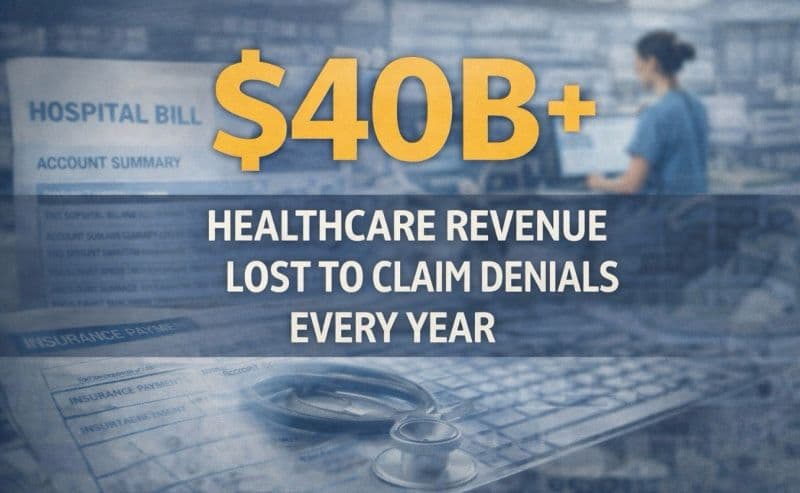
U.S. healthcare providers lose over $40B annually to claim denials.
Not because the revenue isn't recoverable. But because no one had time to chase it.
The conversation that put it into focus
Last week I was on a call with a revenue cycle leader at a small, rural hospital.
They had claims sitting in A/R for over 60 days. Not because the claims were complex. Not because they were incorrect. But because their team simply couldn't keep up.
Every follow-up meant navigating IVRs, sitting on hold, waiting to reach a payer. Thirty minutes. Forty minutes. Sometimes more.
With a lean team, that meant a hard trade-off: work new claims, or chase old ones?
Over time, the answer becomes obvious. You move forward. And some revenue gets left behind — not written off by policy, but abandoned by capacity.
The real bottleneck in healthcare RCM
That's the core problem facing hospitals and physician groups across the country today.
It's not knowledge. It's not effort. It's throughput.
The math is straightforward:
- Fewer claims worked → higher days in A/R
- Higher A/R → delayed cash
- Delayed cash → margin pressure
For rural hospitals and smaller physician groups operating on thin margins, that delay isn't just operational. It's existential.
What's changing now
For the first time, the work that created the bottleneck — IVR navigation, hold queues, denial follow-up, repetitive payer calls — can be offloaded. Not to more staff. To systems that don't
wait.
AI voice agents can handle payer interactions at scale: working claims continuously, following up without delay, and freeing your human team to focus on cases that actually require judgment.
Same workflows. Very different throughput.
The question has changed
The question is no longer how hard your team works.
It's how much of your revenue your system allows you to recover.
---
$40B in Denied Claims Isn't a Knowledge Problem. It's a Throughput Problem.
U.S. healthcare providers lose over $40B annually to claim denials — not because revenue isn't recoverable, but because teams don't have capacity to chase it.